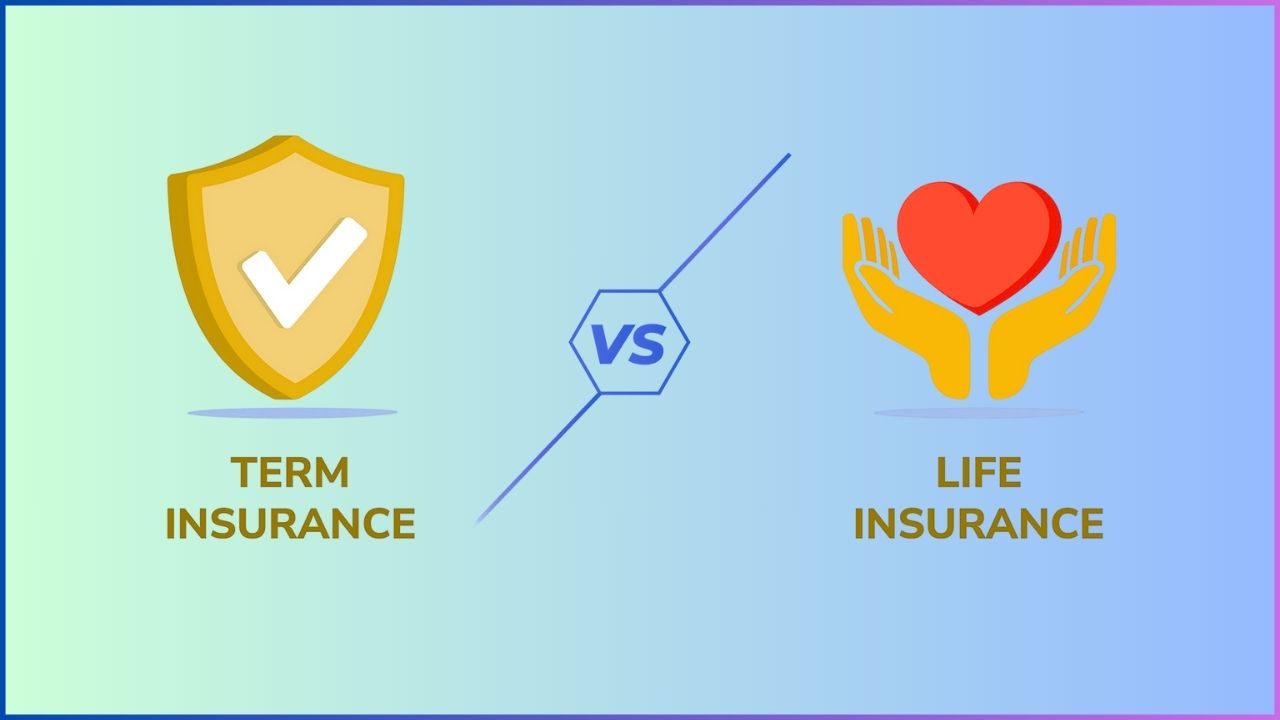

In today’s money planning environment, two terms you’ll hear used a lot are term insurance and life insurance. Both help shield your loved ones financially, but they function in quite dissimilar manners. Here’s all you need to know about both, how they differ, and which one may be best for you.
What Is Term Insurance?
- Coverage Period: A fixed number of years (usually 10–35 years).
- Death Benefit: Paid to your beneficiary if you die within the chosen term.
- Maturity Benefit: Generally no payout if you survive the term.
- Premiums: Lower, more affordable than life insurance.
- Flexibility: Limited—once the term ends, coverage stops unless you renew (often at higher rates).
Key Points
- You choose the length of your cover based on your needs (for example, until children finish college or your home loan is paid off).
- Because there’s no savings component, premiums stay low.
- If you outlive the policy, you get no maturity payout—you only get value if you pass away during the term.
What Is Life Insurance?
- Coverage Period: Can cover you for your entire lifetime (or for a set term with savings features).
- Death Benefit: Paid to your beneficiary whenever you die while the policy is active.
- Maturity Benefit: Often payable if you survive the policy term (in the form of cash value or bonuses).
- Premiums: Higher, reflecting both protection and a savings/investment component.
- Flexibility: More—you may earn bonuses, have partial withdrawals, paid‑up value, or surrender value.
Key Points
- Combines protection with a savings or investment element.
- Builds up a “cash value” over time that you can borrow against or withdraw (subject to terms).
- Premiums fund both the risk cover and the savings portion, so they cost more than term plans.
Term Insurance vs. Life Insurance: At a Glance
| Difference | Term Insurance | Life Insurance |
|---|---|---|
| Coverage | Only covers premature death within the term | Covers death at any time while policy is active |
| Premiums | Low and affordable | Higher rates (includes savings component) |
| Maturity Benefit | Usually not payable | Payable if you survive the term, plus bonuses |
| Death Benefit | Payable upon death during term | Payable upon death at any time |
| Term Length | 10 to 35 years | 5 to 30 years (or whole life) |
| Paid‑Up/Surrender Value | No paid‑up or surrender value | Yes—if premiums stop after a few years, you get paid‑up value; can surrender for cash |
| Flexibility | Not flexible—no savings or bonus options | Very flexible—bonuses, loans, partial withdrawals |
Detailed Comparison
- Coverage
- Term Insurance: Only protects if you die within the policy term.
- Life Insurance: Protects against death at any time while the policy is active, and may pay out if you live past a set date.
- Premiums
- Term: Lower because it only covers risk.
- Life: Higher because part of your premium builds a savings component.
- Bonuses & Additions
- Term: No bonuses or guaranteed additions.
- Life: Policies often add annual bonuses, loyalty additions, or guaranteed additions to boost savings.
- Paid‑Up & Surrender Value
- Term: No cash value—even if you stop paying, you get nothing back, and coverage ends.
- Life: After paying premiums for a minimum period, you build a paid‑up value. On surrender, you receive a surrender value.
- Flexibility
- Term: Fixed cover—no savings, no loan facility, no maturity benefit.
- Life: Flexible—policy loans, partial withdrawals, and maturity payouts.
Also Read
Which One Should You Choose?
- Choose Term Insurance If:
- You need pure protection at the lowest cost.
- You want cover only for a specific period (e.g., until kids finish college).
- You don’t need a savings component.
- Choose Life Insurance If:
- You want both protection and a guaranteed savings element.
- You can afford higher premiums for lifelong cover or maturity benefits.
- You value flexibility—bonuses, cash value, or surrender options.
Wrapping Up
Both term and life insurance are important parts of a sound financial plan:
- Term Insurance gives you affordable, high‑sum coverage for a set period.
- Life Insurance combines lifelong protection with savings and bonus features.
Select the plan which best suits your means, the length of cover required, and whether you want a savings element as well as protection.
Disclaimer: This blog is solely for educational purposes. It does not recommend any specific policy or insurer. Always consult a licensed insurance advisor before making a decision.