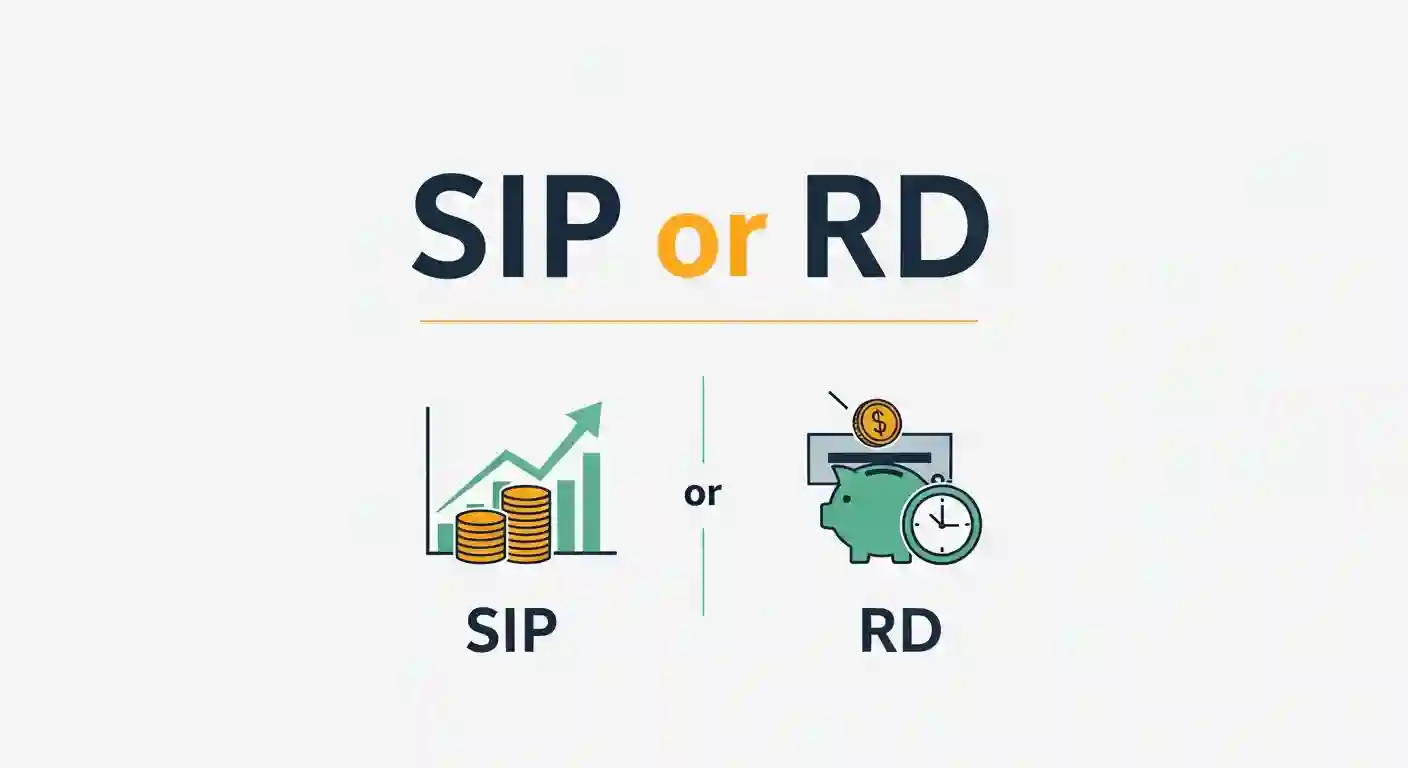

When it comes to saving or investing money on a regular basis, two popular options always come into consideration: SIP (Systematic Investment Plan) and RD (Recurring Deposit). Both are quite popular, easy to start, and ideal for those who want to accumulate wealth in a gradual manner. However, the major question still persists: which one is better, SIP or RD?
The truth is—it depends. In this blog post, we will introduce you to SIP and RD in simple English, compare them side by side, and help you decide which one is more suitable for you. No technical terms, no finance speak—just straightforward information.
Understanding SIP in Simple Terms
Systematic Investment Plan (SIP) is an investment option where you can invest a fixed amount of money on a regular basis (monthly, quarterly, or weekly) in a mutual fund. Instead of investing a lump sum amount of money, you invest a small amount of money over a period of time.
Suppose you have decided to start a SIP of ₹5,000 per month. In this case, the amount of ₹5,000 will be automatically invested in a mutual fund of your choice. After a period of time, your money will grow based on the performance of the market.
How SIP Works
- You choose a mutual fund
- You decide a fixed amount and date
- Money is deducted automatically from your bank account
- Units are bought at different market prices
- Over time, this helps average out costs (called rupee cost averaging)
SIP is mainly used for long-term wealth creation, especially for goals like retirement, children’s education, or buying a house.
Understanding RD in Simple Terms
A Recurring Deposit (RD) is a traditional saving option offered by banks and post offices. You deposit a fixed amount every month for a fixed period at a guaranteed interest rate.
For example, you open an RD of ₹5,000 per month for 3 years. At the end of the term, you get your total deposit plus interest.
How RD Works
- You choose a bank or post office
- You fix the monthly deposit and tenure
- Interest rate is fixed from the start
- Money grows safely over time
- You get a guaranteed return at maturity
RD is mainly used for safe savings and short- to medium-term goals.
Key Difference Between SIP and RD
Let’s understand the main differences in a simple comparison:
| Feature | SIP | RD |
|---|---|---|
| Type | Investment | Savings |
| Risk | Market-linked (higher risk) | Very low risk |
| Returns | Not fixed, can be high | Fixed and guaranteed |
| Ideal For | Long-term goals | Short-term goals |
| Inflation Protection | Good | Poor |
| Flexibility | High | Moderate |
| Tax Benefit | Available in some SIPs (ELSS) | No tax benefit |
Returns: SIP vs RD
This is one of the most important factors people consider.
Returns from SIP
SIP returns depend on the market. Historically, equity mutual funds have given 10–14% average annual returns over the long term. However, returns are not guaranteed and may fluctuate in the short term.
The longer you stay invested, the better your chances of earning higher returns.
Returns from RD
RD offers fixed returns, usually between 5–7% per year, depending on the bank and tenure. There are no surprises—what you see is what you get.
However, RD returns often struggle to beat inflation in the long run.
Risk Factor: Which Is Safer?
If safety is your top priority, RD is safer than SIP.
- RD: Your money is safe, returns are guaranteed, and there is no market risk.
- SIP: Your money is invested in the market, so there can be ups and downs.
That said, SIP risk reduces significantly when you invest for the long term. Short-term market volatility becomes less important over time.
Impact of Inflation
Inflation quietly reduces the value of money over time. This is where SIP has an edge.
- SIP: Has the potential to beat inflation and grow your real wealth.
- RD: Often fails to beat inflation, meaning your money grows, but its purchasing power may not.
If your goal is long-term wealth creation, SIP usually performs better against inflation.
Taxation: SIP vs RD
Tax on SIP
- Tax depends on the type of mutual fund
- Equity SIPs held for more than one year enjoy lower long-term capital gains tax
- ELSS SIPs also offer tax deduction under Section 80C
Tax on RD
- Interest earned on RD is fully taxable
- Tax is added to your income and taxed as per your slab
- TDS may apply in some cases
From a tax point of view, SIP can be more efficient than RD.
Flexibility and Convenience
Both SIP and RD are easy to start, but SIP offers more flexibility.
SIP Flexibility
- Start with as low as ₹500 per month
- Pause, stop, or change amount anytime
- Switch between funds if needed
RD Flexibility
- Fixed monthly amount
- Premature withdrawal may attract penalty
- Less flexible compared to SIP
If you want control and flexibility, SIP is the better choice.
Which Is Better for Different Financial Goals
Let’s make this even simpler by matching goals with the right option.
Choose SIP If
- Your goal is long-term (5+ years)
- You want higher returns
- You can handle market ups and downs
- You want to beat inflation
- You are planning for retirement or wealth creation
Choose RD If
- Your goal is short-term (1–3 years)
- You want guaranteed returns
- You cannot take any risk
- You are saving for emergency funds or short-term needs
Can You Do Both SIP and RD?
Yes, and in fact, many people do.
A smart approach is to:
- Use RD for safety and short-term goals
- Use SIP for growth and long-term goals
This way, you balance safety and returns without stress.
Final Verdict: SIP or RD – Which Is Better?
There is no single winner that suits everyone.
- SIP is better for long-term wealth creation and beating inflation
- RD is better for safe savings and short-term goals
If you are young, earning regularly, and investing for the future, SIP usually works better. If you prefer safety and certainty, RD is the right choice.
The best option is the one that matches your goals, comfort level, and time horizon.
Conclusion
It is not necessary to get confused between SIP and RD. Both are very useful financial instruments if used properly. SIP will help you increase your wealth, whereas RD will help you save money with discipline.
You should understand your requirements and choose the one that will make you sleep peacefully at night. Consistency is more important than the choice itself in the long run.
Learn More:
- Blue-Chip Stocks vs. Penny Stocks
- Delivery vs Intraday Trading
- Difference in Expense Ratio Between Direct and Regular Mutual Funds
- Best Small-Cap Index Funds
- 10 Debt Mutual Funds That Outperformed in the Last 1 Year with 10% to 24% Returns in 2025
Disclaimer: This blog is for educational purposes only. Mutual fund investments are subject to market risks. Read all scheme-related documents carefully before investing.