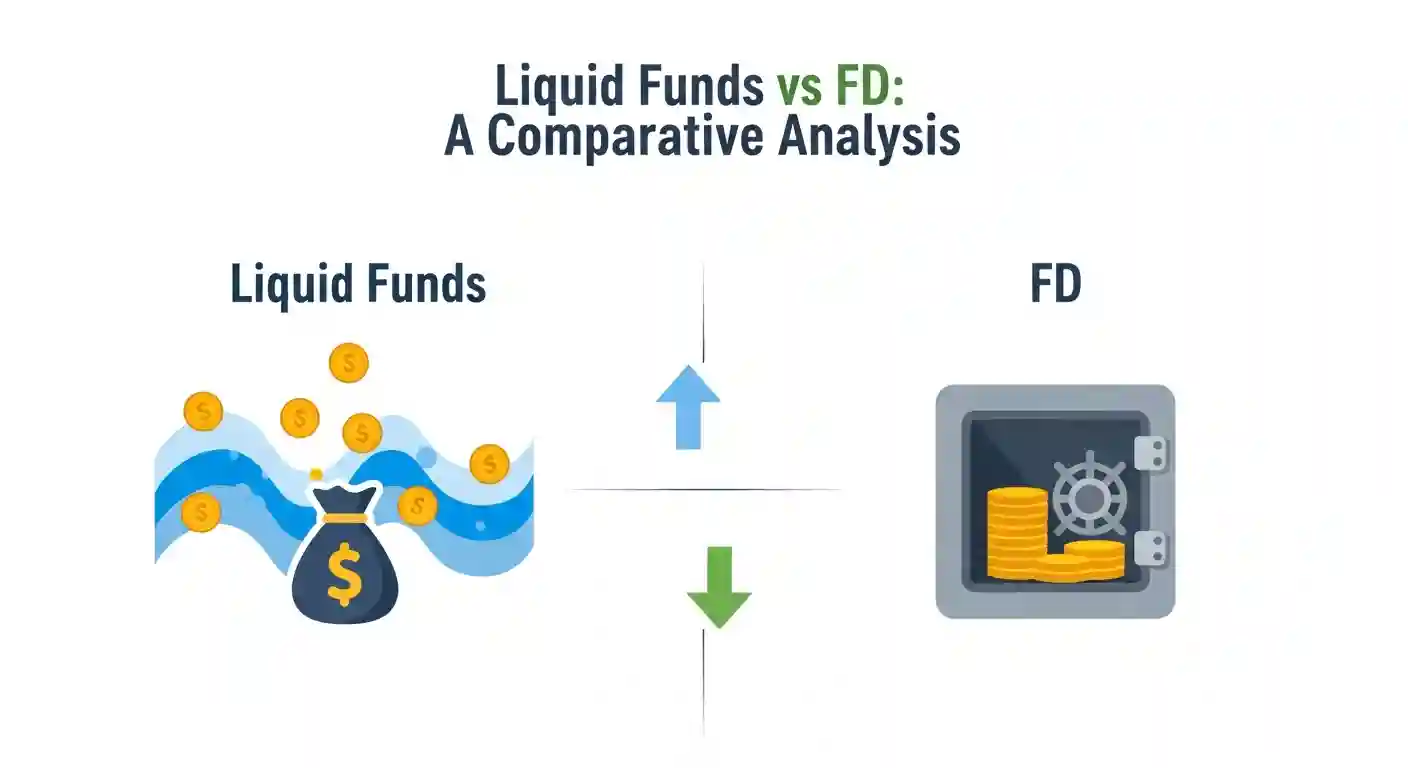

Liquid Funds vs FD- For many years, fixed deposits have been the trusted and preferred investment instrument of Indians. They have been the preferred option of anyone looking for safe, steady, and decent returns, having minimal risk, even before mutual funds and stock markets gained acceptance as popular investment avenues.
However, times have changed, and new investment instruments have developed to suit different requirements. One of those instruments is, therefore, a liquid fund, which is a debt fund that ensures a similar level of safety offered by FDs but better liquidity along with possibly higher yields.
If you are confused between the concepts of liquid funds and FD, this blog will aid you in understanding the two concepts and will help you make the right decision.
What are Fixed Deposits (FDs)?
Fixed deposits are one of the most conservative investment options offered by banks and non-banking financial companies (NBFCs) in India. When you invest in an FD:
- You deposit a lump sum amount for a fixed period (from 7 days to 10 years).
- The bank or NBFC pays you a fixed interest rate throughout the tenure.
- Your principal and interest (up to ₹5 lakh per bank) are insured under the DICGC scheme, making FDs extremely safe.
Key Features of FDs
- Low Risk: FDs are considered very safe, especially bank FDs.
- Fixed Returns: The interest rate is locked at the time of investment and doesn’t change.
- Low Liquidity: You can withdraw early, but a penalty is usually charged.
- Taxation: Interest earned is added to your income and taxed as per your income tax slab. Banks deduct 10% TDS on interest.
What are Liquid Funds?
Liquid funds are a type of debt mutual fund that invests in short-term, low-risk fixed-income instruments like treasury bills, commercial papers, and certificates of deposit. These instruments have a maturity of up to 91 days.
Liquid funds are designed for investors who want:
- Better returns than savings accounts or FDs.
- High liquidity to park surplus money for the short term.
- Low to moderate risk with market-linked returns.
Key Features of Liquid Funds
- Low to Moderate Risk: Slightly riskier than FDs as they are market-linked.
- Better Returns: Typically offer higher returns than FDs.
- High Liquidity: You can redeem units anytime, usually within 1-2 working days.
- Taxation: Depends on holding period—if held for more than 3 years, taxed at 20% after indexation; if less than 3 years, taxed as per your income slab.
Liquid Funds vs FD: A Comparative Analysis
Here’s a detailed side-by-side comparison to help you understand the key differences:
| Feature | Fixed Deposits (FDs) | Liquid Funds |
|---|---|---|
| Risk | Very low risk. Insured up to ₹5 lakh per bank under DICGC. | Low to moderate risk. Market-linked, but invests in high-quality, short-term instruments. |
| Returns | Fixed returns, typically 5-7% per annum depending on the bank and tenure. | Variable returns, usually 6-8% or more, depending on market conditions. |
| Liquidity | Premature withdrawal allowed but with a penalty (usually 0.5-1% of interest). | High liquidity. You can redeem anytime. SEBI has introduced a graded exit load for redemptions within 7 days, but it’s minimal. |
| Investment Horizon | 7 days to 10 years. | Up to 91 days (ideal for short-term parking of funds). |
| Taxation | Interest is added to your income and taxed as per your tax slab. 10% TDS is deducted by the bank. | Short-term (less than 3 years): Taxed as per income slab. Long-term (more than 3 years): 20% tax with indexation benefit. |
| Guaranteed Returns | Yes, returns are guaranteed. | No, returns are not guaranteed but historically stable. |
| Lock-in Period | No mandatory lock-in, but early withdrawal penalties apply. Tax-saving FDs have a 5-year lock-in. | No lock-in, but exit load applies if redeemed within 7 days. |
| Insurance | Deposits up to ₹5 lakh are insured under DICGC. | No insurance, but invests in highly rated instruments. |
Exit Load on Liquid Funds (Recent SEBI Rule)
Previously, liquid funds had no exit load. However, SEBI introduced a graded exit load structure for redemptions made within 7 days. Here’s how it works:
| Holding Period | Exit Load (%) |
|---|---|
| 1 day | 0.0070% |
| 2 days | 0.0065% |
| 3 days | 0.0060% |
| 4 days | 0.0055% |
| 5 days | 0.0050% |
| 6 days | 0.0045% |
| 7 days onwards | 0% (No exit load) |
Even with this exit load, liquid funds offer better liquidity than FDs at much lower penalty charges.
Who Should Invest in Fixed Deposits?
FDs are ideal for:
- Risk-averse investors who prioritize safety and guaranteed returns over higher returns.
- Conservative investors who want to earn better returns than a savings account without taking any market risk.
- Long-term savers who don’t need immediate access to their money and are comfortable with penalties for early withdrawal.
- Retirees or senior citizens who want predictable, stable income.
Pro Tip: Always check the credit rating of NBFCs before investing in their FDs. Bank FDs are generally safer.
Who Should Invest in Liquid Funds?
Liquid funds are ideal for:
- Short-term investors who want to park surplus money for a few days to 3 months.
- Emergency fund parking: Those who need quick access to funds without significant penalties.
- Moderate risk-takers who are comfortable with slight market fluctuations but want stable returns.
- Tax-efficient investors who plan to hold for more than 3 years and want to benefit from indexation.
Conclusion
Both liquid funds and fixed deposits serve different purposes and cater to different types of investors.
- Choose FDs if you want zero risk, guaranteed returns, and insurance protection, and you don’t mind penalties for early withdrawal.
- Choose Liquid Funds if you want better returns, high liquidity, and are okay with low to moderate market risk.
Liquid funds are not a replacement for FDs but a better alternative for short-term parking of surplus funds with higher returns and better liquidity. They are safer than most other mutual funds but still carry slightly more risk than FDs.
As always, assess your risk tolerance, investment horizon, and financial goals before making a decision.
Learn More: