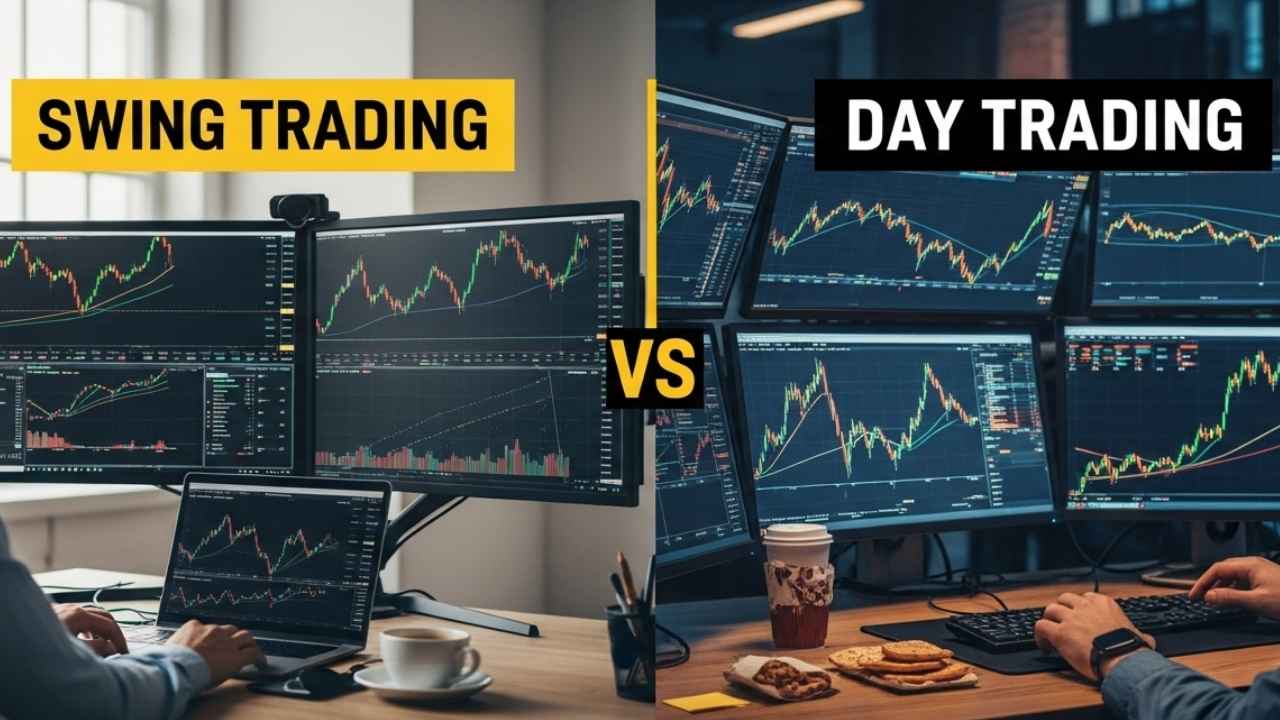

When it comes to stock market trading, two popular styles are swing trading and day trading. Each has its own approach, risks, and rewards. If you’re new to trading, understanding the difference between swing trading and day trading can help you choose the style that suits your personality and goals.
What is Swing Trading?
Swing trading is a method where traders aim to profit from short-term price movements in stocks or other financial instruments. Swing traders typically hold positions for a few days to several weeks. They use technical analysis to identify trends and patterns, and then enter and exit trades based on these signals.
What is Day Trading?
Day trading involves buying and selling stocks within the same trading day. Day traders close all their positions before the market closes, so they don’t carry any overnight risk. This style is popular for capitalizing on small price fluctuations and requires quick decision-making.

Major Differences Between Swing Trading and Day Trading
| Particulars | Swing Trading | Day Trading |
|---|---|---|
| Meaning | Holding positions for a few days to several weeks | Buying and selling within the same day |
| Leverage | Typically 2x the initial capital | Typically 4x the initial capital |
| Risk Involved | Higher risk due to overnight holding | Lower risk as positions are closed daily |
| Role | Can be done part-time | Usually a full-time job |
| Security Holding Period | A few days to several weeks | Less than a day |
| Tools Used | Charting systems, pattern analysis | Technical analysis, charting technologies |
| Time Required | Less time spent on the market | More time spent on the market |
| Execution of Trade | More time to track market movement | Quick execution required |
| Capital Requirements | More capital needed | Less capital needed |
| Which is Safer? | Higher risk due to overnight holding | Lower risk as positions are closed daily |

Trading Strategies
Swing Trading Strategies
- Fibonacci Retracement: Used to identify potential buy and sell points based on price retracements.
- T-Line: Helps traders decide when to enter or exit a trade based on the closing price relative to the T-Line.
- Japanese Candlesticks: Used to analyze stock market trends and identify bullish or bearish patterns.
Day Trading Strategies
- Scalping Strategy: Involves making small profits from frequent trades, focusing on price action.
- Momentum Strategy: Involves tracking the momentum of the market and making quick decisions based on news and market trends.

Conclusion
Both swing trading and day trading have their own advantages and risks. Swing trading is suitable for those who can dedicate less time and are comfortable with overnight risk, while day trading is ideal for those who can commit full-time and prefer quick, frequent trades. Your trading personality and goals will help you choose the best style for you.
Remember, both trading methods involve significant risks, so it’s important to do thorough research and consider your risk tolerance before starting. Happy trading!
Learn More:
- Blue-Chip Stocks vs. Penny Stocks
- Delivery vs Intraday Trading
- Difference in Expense Ratio Between Direct and Regular Mutual Funds
- Best Small-Cap Index Funds
- 10 Debt Mutual Funds That Outperformed in the Last 1 Year with 10% to 24% Returns in 2025
Disclaimer: This blog is for educational purposes only. The securities/investments quoted here are not recommendatory.