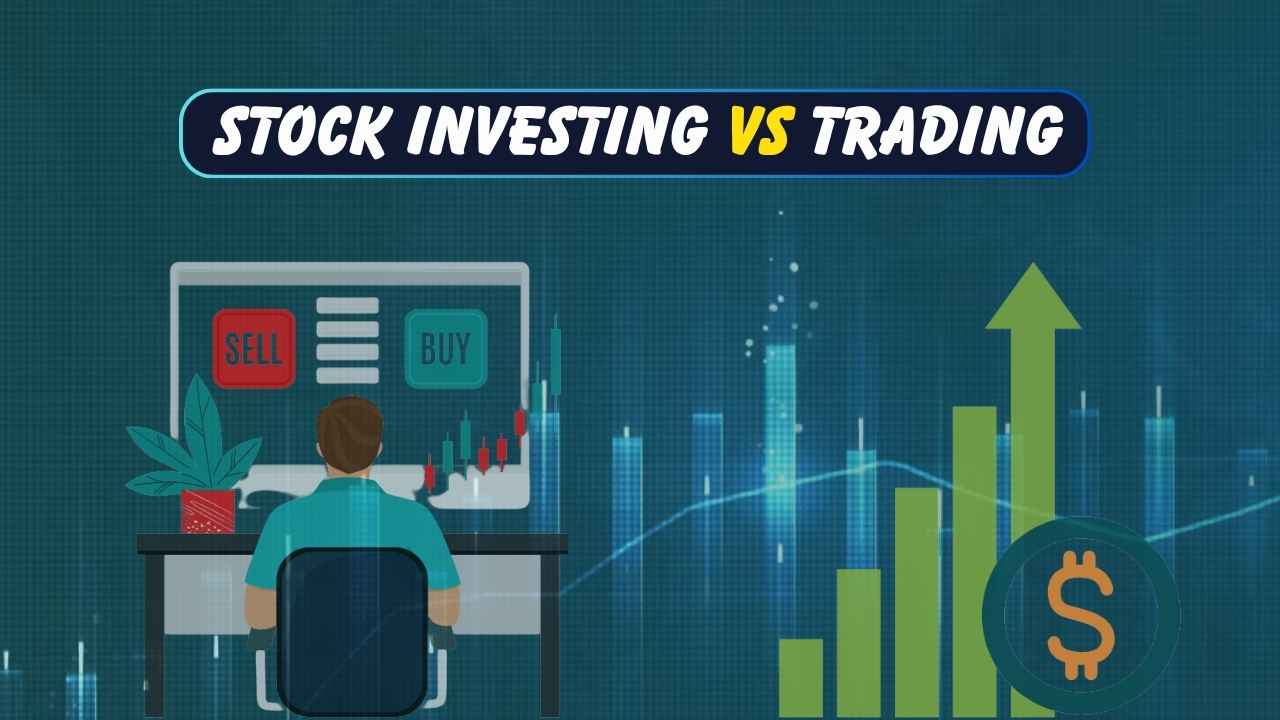

Trading vs investing- When you enter the stock market, you’ll hear two terms a lot: investing and trading. Many beginners think they’re the same thing. But they’re actually quite different. Understanding these differences can help you choose the right approach for your financial goals.
In this blog, we’ll break down the key differences between stock investing and trading in simple language. Let’s get started.
What is Stock Investing?
Stock investing is when you buy shares of a company and hold them for a long time. The goal is to build wealth gradually over years or even decades.
Think of it like planting a tree. You plant it today, water it regularly, and wait patiently. Over time, it grows bigger and stronger. Similarly, when you invest in stocks, you’re betting on the company’s long-term growth.
How Does Investing Work?
When you invest, you:
- Buy shares of good companies
- Hold them for several years
- Earn returns through price appreciation and dividends
- Focus on the company’s fundamentals and future potential
For example, if you bought shares of Infosys or TCS ten years ago and held them, you would have seen significant growth in your investment.
Key Characteristics of Investing
- Time Horizon: Long-term (years or decades)
- Goal: Wealth creation and capital appreciation
- Risk: Lower risk spread over time
- Effort: Less daily monitoring required
- Approach: Buy and hold strategy
- Analysis: Focus on fundamental analysis

What is Stock Trading?
Stock trading is when you buy and sell shares quickly to make short-term profits. Traders don’t hold stocks for long. They might hold them for minutes, hours, days, or weeks.
Think of it like running a sprint. You need speed, quick reactions, and constant attention. Traders capitalize on short-term price movements in the market.
How Does Trading Work?
When you trade, you:
- Buy and sell stocks frequently
- Look for short-term price movements
- Use technical analysis and charts
- Make quick decisions based on market trends
For example, if you buy a stock at ₹100 in the morning and sell it at ₹110 by evening, you make a quick profit of ₹10.
Types of Trading
- Day Trading: You buy and sell stocks within the same day. Positions are closed before the market closes.
- Swing Trading: You hold stocks for a few days or weeks, waiting for favorable price changes.
- Positional Trading: You hold stocks for a few weeks to months, focusing on larger price movements.
Key Characteristics of Trading
- Time Horizon: Short-term (minutes to months)
- Goal: Quick profits from price movements
- Risk: Higher due to market volatility
- Effort: Requires constant attention and monitoring
- Approach: Frequent buying and selling
- Analysis: Focus on technical analysis

Key Differences Between Investing and Trading
Let’s compare investing and trading side by side:
| Aspect | Investing | Trading |
|---|---|---|
| Time Period | Long-term (years or decades) | Short-term (minutes, days, or weeks) |
| Goal | Wealth creation over time | Quick profits from price movements |
| Risk | Lower, spread over time | Higher due to market volatility |
| Effort | Less time and monitoring | Constant attention and quick decisions |
| Approach | Buy and hold | Frequent buying and selling |
| Analysis | Fundamental analysis | Technical analysis |
| Returns | Gradual growth over time | Potential for quick gains or losses |
| Transaction Frequency | Rare | Very frequent |
| Market Focus | Company health and long-term trends | Short-term price movements and charts |
| Leverage | Rarely used | Frequently used |
| Emotional Control | Requires patience | Requires fast reactions |
| Tax Implications | Lower long-term capital gains tax | Higher short-term capital gains tax |

Common Mistakes to Avoid
For Investors:
- Panicking during market downturns
- Checking portfolio too frequently
- Chasing hot stocks without research
- Not diversifying
- Having unrealistic expectations
For Traders:
- Trading without a plan
- Using too much leverage
- Not using stop-loss orders
- Letting emotions control decisions
- Overtrading and racking up costs
Real-Life Example
Let’s say you believe in a company like Reliance Industries.
As an Investor: You buy 100 shares at ₹2,000 each (₹2,00,000 investment). You hold them for 5-10 years. As the company grows, the stock price reaches ₹3,500. Your investment is now worth ₹3,50,000. You also earned dividends over the years.
As a Trader: You buy 100 shares at ₹2,000 in the morning. By afternoon, the price rises to ₹2,020. You sell immediately, making ₹2,000 profit in one day. You repeat this process multiple times.
Final Thoughts
Stock investing and trading are two different paths to making money in the stock market. Investing is like a slow and steady marathon, while trading is like a fast-paced sprint.
Investing focuses on long-term growth, requires less effort, carries lower risk, and is suitable for most people, especially beginners. Trading focuses on short-term profits, requires constant attention, carries higher risk, and suits experienced market participants.
The key is to understand your financial goals, risk appetite, time availability, and skill level. Choose the approach that fits your lifestyle and objectives. And remember, you don’t have to pick just one—you can do both!
Whether you invest, trade, or do both, always:
- Do thorough research
- Understand the risks
- Start small
- Learn continuously
- Stay disciplined
- Keep emotions in check
The stock market offers opportunities for everyone. The question is: Are you a marathon runner or a sprinter? Your answer will guide you to the right path.
Learn More: